Drawing the Route
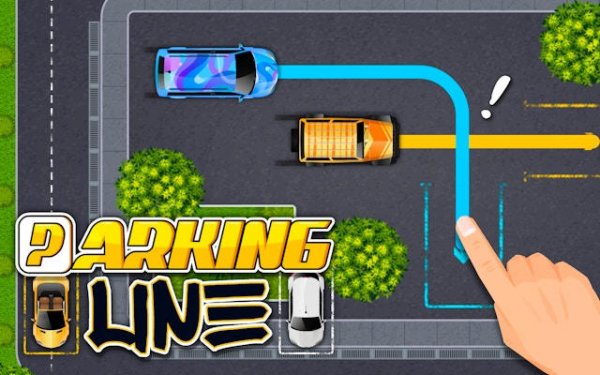
Path Parking Puzzle replaces direct steering with a single drawn line. You examine the parking layout, then use a finger or mouse to trace a continuous path from the car to the designated spot. Releasing the line sends the car along that exact route. The challenge is not reflexes but foresight: the car's turning radius means a line that looks fine on screen can produce a collision when the vehicle actually follows it.
Reading the Lot
Each level presents a new arrangement of walls, parked cars, and other obstacles. Because there are no time limits, you can study the geometry before committing to a line. The real decision is where to place your turns. Sharp angles often fail because the car cannot pivot tightly enough, while a smoother curve through the same gap usually succeeds. This makes every level a small spatial reasoning problem rather than a test of speed.
Failure as Feedback
When the car hits an obstacle or stops short of the spot, the attempt ends and you can redraw. That loop is the core of the game: draw, watch, adjust. The visual feedback shows exactly where the path broke down, so each retry is an informed revision rather than a guess. Patience matters more than precision, since the game never pressures you to rush.
Who It Suits
The controls are simple enough for any age, and the clean visuals keep attention on the puzzle itself. Players who enjoy logic puzzles, map-planning, or games that reward thinking before acting will find the format familiar but distinct. Those looking for fast driving action or direct car control should note that this is a planning game first.






Comments
0 comments