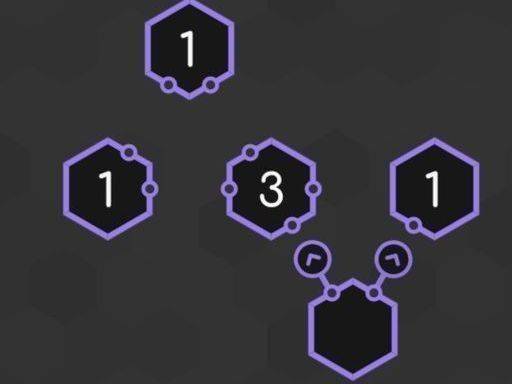
How the Hexagon Chain Works
Each board is a cluster of hexagonal tiles, and every tile carries a number. A single tap reduces that tile's value by one, but the reduction frequently spreads to neighboring hexagons. Because one tap can change several tiles at once, you cannot treat any tile in isolation. Early boards keep the layout small and the interactions limited, which lets you see the cause-and-effect pattern before the grid becomes more layered. As the board grows, the relationships between tiles demand more thought before each tap, since a move that helps one tile may push another in an unwanted direction.
Difficulty That Grows Without Pressure
The difficulty curve starts gently. Initial puzzles use small boards and low numbers, so newcomers can experiment without penalty. Later configurations introduce larger grids and higher starting values, which require longer sequences of moves. Some puzzles are built so that certain tiles must be reduced before others; tapping in the wrong order can reset progress on a tile you already cleared. When you feel stuck, the hint system shows which tile to tap next, offering a nudge without revealing the full solution.
Calm Visuals and Flexible Play Sessions
The interface is clean and minimal, with soft pastel backgrounds that reduce eye strain. Hexagons are clearly outlined, and numbers use a readable font. Subtle color changes mark when a tile reaches zero, giving clear feedback without distraction. There are no timers, no scoring system, and no penalties for wrong moves, so you set the pace. A simple puzzle might take a minute or two, while a complex board can require ten minutes of planning. This makes the game suitable for short breaks or longer relaxation sessions, and the layout adapts to different screen sizes, so it works on a phone or a computer.










Comments
0 comments