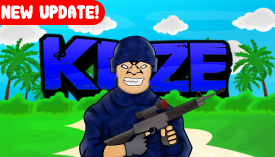
Core Gameplay Loop
Survival Zone: Multiplayer Arena drops participants into a shared environment where the primary goal is to be the final survivor. Each match begins with players spawning in a central hub before being released onto the map. From there, the focus shifts to collecting resources scattered across the terrain. These materials are essential for constructing defensive structures and upgrading equipment. The game emphasizes strategic decision-making under pressure, as every action—from gathering to building—must be balanced against the movements of other players.
Resource Gathering and Construction
Resources appear randomly across the map, ensuring no two matches feel identical. Players can harvest wood, stone, and other raw materials from the environment. These items are used to erect walls, barriers, and other defensive positions. The construction system is straightforward: a dedicated mode allows players to place structures quickly, turning an open field into a fortified camp. Managing inventory space becomes critical, as carrying too many materials can slow movement, while carrying too few leaves a player vulnerable.
Shrinking Safe Zone Dynamics
A defining feature of Survival Zone: Multiplayer Arena is the contracting safe zone. At regular intervals, the playable area reduces, pushing participants closer together. This mechanic prevents stalemates and ensures matches remain fast-paced. Players must constantly monitor their position relative to the boundary, as being caught outside results in rapid elimination. The shrinking zone creates natural chokepoints and ambush opportunities, rewarding those who plan their routes ahead of time.
Tools and Equipment Variety
Throughout a match, players can open containers to find different tools. These include ranged options for engaging opponents from a distance, rapid-fire devices for close encounters, and area-effect items that can control space. Each tool has a distinct use case, and mastering them is key to success. The game does not lock players into a single playstyle; instead, it encourages experimentation with different combinations of tools and defensive structures.
Player Interaction and Strategy
Since every participant is a potential threat, social dynamics play a subtle role. Some players may choose to avoid conflict early, focusing on building a strong base. Others may adopt an aggressive approach, hunting for resources by defeating others. Observing opponent behavior and adapting one's strategy accordingly is a core skill. The unpredictable nature of human opponents means that no two matches unfold the same way, adding replay value.





Comments
0 comments